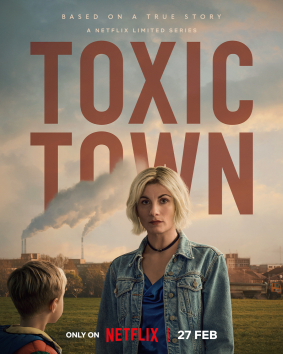
The True Story of Toxic Town: Unraveling Corby's Poisoning Scandal
The recent Netflix drama, Toxic Town, has brought a harrowing true story into the spotlight, captivating audiences with its portrayal of an environmental scandal that rocked the English town of Corby. More than just a compelling series, Toxic Town delves into the real-life struggle of mothers who fought tirelessly for justice after their children were born with devastating birth defects, a tragedy linked to pervasive toxic dust in the air. This landmark case, often dubbed the "British Erin Brockovich," serves as a stark reminder of the long-term consequences of environmental negligence and the indomitable spirit of those who refuse to be silenced.
In 2009, a groundbreaking civil court ruling connected the negligent management of toxic waste in Corby to these tragic birth defects, setting a crucial precedent in English law. This article explores the true events behind Toxic Town, unraveling the layers of industrial legacy, scientific discovery, and profound human courage that defined one of the UK's most significant environmental legal battles.
Corby's Industrial Heartbeat: The Genesis of a Toxic Problem
For decades, Corby thrived as a prominent steel-producing town, with British Steel serving as its industrial backbone. When the plant eventually closed, a massive and complex decontamination project was initiated across its former sites. This undertaking, managed by the Corby Borough Council, involved reclaiming vast expanses of land previously contaminated by industrial activities. However, it was during this very process that the seeds of a future tragedy were inadvertently sown.
The scale of the clean-up was immense, involving the movement of vast quantities of soil and waste materials. While the intention was to rehabilitate the land, the methods employed were critically flawed. Reports later revealed that proper measures to contain the hazardous dust generated by the earthworks were not consistently applied. Consequently, winds routinely carried clouds of this orange-tinged particulate matter across the town, permeating homes, schools, and public spaces. Unknown to the residents at the time, this dust contained a cocktail of dangerous heavy metals and toxins, including arsenic, zinc, boron, and nickel – substances whose levels far exceeded environmental safety guidelines, even after supposed clean-up efforts. The air itself became a silent, insidious threat.
Unveiling the Unthinkable: A Cluster of Birth Defects and a Journalist's Tip-Off
For many residents, particularly expectant mothers, life in Corby continued as normal. However, a disturbing pattern began to emerge in local hospitals. Mothers like Susan McIntyre, portrayed by Jodie Whittaker in Toxic Town, experienced the devastating shock of giving birth to children with severe limb deformities, such as missing fingers or hands. Initially, these seemed like isolated, tragic incidents. Yet, as more children were born with similar abnormalities, a growing sense of unease settled over the community. Mothers found themselves sharing hospital rooms, stories, and ultimately, a chilling suspicion: could there be a connection?
The turning point arrived in 1999 when journalist Graham Hind, acting on a tip, began investigating problems with the decontamination efforts and the cluster of birth defects in Corby. His subsequent article in the Sunday Times, co-written with Stephen Bevan, was a watershed moment. It not only brought the story to national attention but also provided the crucial link the mothers needed. The article revealed that these children lived or worked close to the network of former steelworks sites where toxic waste was being managed. Hind and Bevan gained access to an auditors' report that confirmed the alarming levels of contaminants present in the supposedly "cleaned" quarry sites, validating the growing fears.
Pediatrician John Scott, who had contributed to research linking birth defects to landfill sites, critically observed that the Corby cluster served as “an early warning that something may be going wrong.” This journalistic revelation was the spark that ignited a collective demand for answers and, ultimately, justice, transforming individual heartache into a shared mission.
The Hard-Fought Battle: Mothers Against the Council
Armed with the truth uncovered by the press, Susan McIntyre and other mothers recognized they were not alone. The Sunday Times article initially highlighted four cases of limb deformities, but the momentum it generated led to 19 families eventually uniting to pursue a class-action lawsuit against the Corby Borough Council. Their journey was arduous, fraught with immense challenges that extended far beyond the courtroom.
These women faced a formidable opponent in a local authority with significant resources, coupled with the inherent complexities of proving a direct causal link between environmental exposure and birth defects. Scientifically, such connections are notoriously difficult to establish, often requiring extensive epidemiological data and expert testimony. Emotionally, the mothers endured the ongoing trauma of their children's conditions while simultaneously battling bureaucratic hurdles, legal skepticism, and the immense financial strain of a prolonged legal fight. They had to relive their most painful experiences, recounting the details of their children's disabilities and their own anxieties time and again. Yet, their determination remained unwavering. Their fight became a powerful testament to parental love and the refusal to accept suffering in silence. It was this unwavering resolve that led many to compare their struggle to the famous American environmental justice case, earning it the moniker, "British Erin Brockovich." The mothers' relentless advocacy became the driving force behind Corby's landmark case, demonstrating the immense power of community action.
A Landmark Ruling and Its Enduring Legacy
After years of tireless campaigning and a gruelling legal battle, justice finally arrived in 2009. The High Court delivered a landmark ruling in favour of the 16 children and their families (three cases were settled earlier), finding the Corby Borough Council liable for negligence in its management of the toxic waste. The court concluded that the council's failure to adequately control the dust emissions from the reclamation sites led to the children's deformities. This verdict was revolutionary: it was the first time a civil court in England had definitively connected specific birth defects to the negligent handling of toxic waste in the air.
The impact of this ruling resonated far beyond Corby. It established a crucial precedent, strengthening environmental protection laws and setting a new standard for corporate and council accountability in managing hazardous materials. The case underscored the critical importance of transparent and rigorously controlled industrial clean-up operations, as well as the need for robust regulatory oversight to protect public health. While the legal victory brought financial compensation and, more importantly, a measure of validation and recognition for the families, it could never erase the profound physical and emotional scars left by the tragedy. The children and their families continue to live with the consequences of the council's negligence, but their courageous fight ensured that their story would serve as a powerful warning and a source of hope for future generations facing similar environmental injustices.
The true story behind Toxic Town is a potent narrative of environmental oversight, community resilience, and the relentless pursuit of justice. It illuminates the potential for harm when industrial activities are not managed with the utmost care and highlights the extraordinary strength of ordinary people who, when faced with unimaginable adversity, stand together to demand accountability. Corby's legacy is not just one of tragedy, but also one of triumph – a testament to the fact that even against overwhelming odds, the voices of the vulnerable can be heard, and change can be achieved.